
EDUCATION Beyond the Gate 🍎
Conversations on life after innocence

What is school, really?
Not the building.
Not the timetable.
Not the attendance code.
Not the uniform.
Not the exam season.
Not the behaviour policy.
Not the spreadsheet pretending to know the child.
School is the place a society reveals what it believes children are.
Are they vessels to be filled?
Risks to be managed?
Workers in preparation?
Citizens in training?
Problems to be corrected?
Souls becoming?
Minds unfolding?
Or living intelligences already in relation with the world?
School is never neutral.
It is always a civilisation’s hidden theology of childhood.
EMBER
EMBER says school is meant to be a hearth.
A place where the small flame is protected long enough to grow stronger.
Not made useful too early.
Not tested until it forgets warmth.
Not compared until it learns envy.
Not shamed until curiosity withdraws underground.
She says:
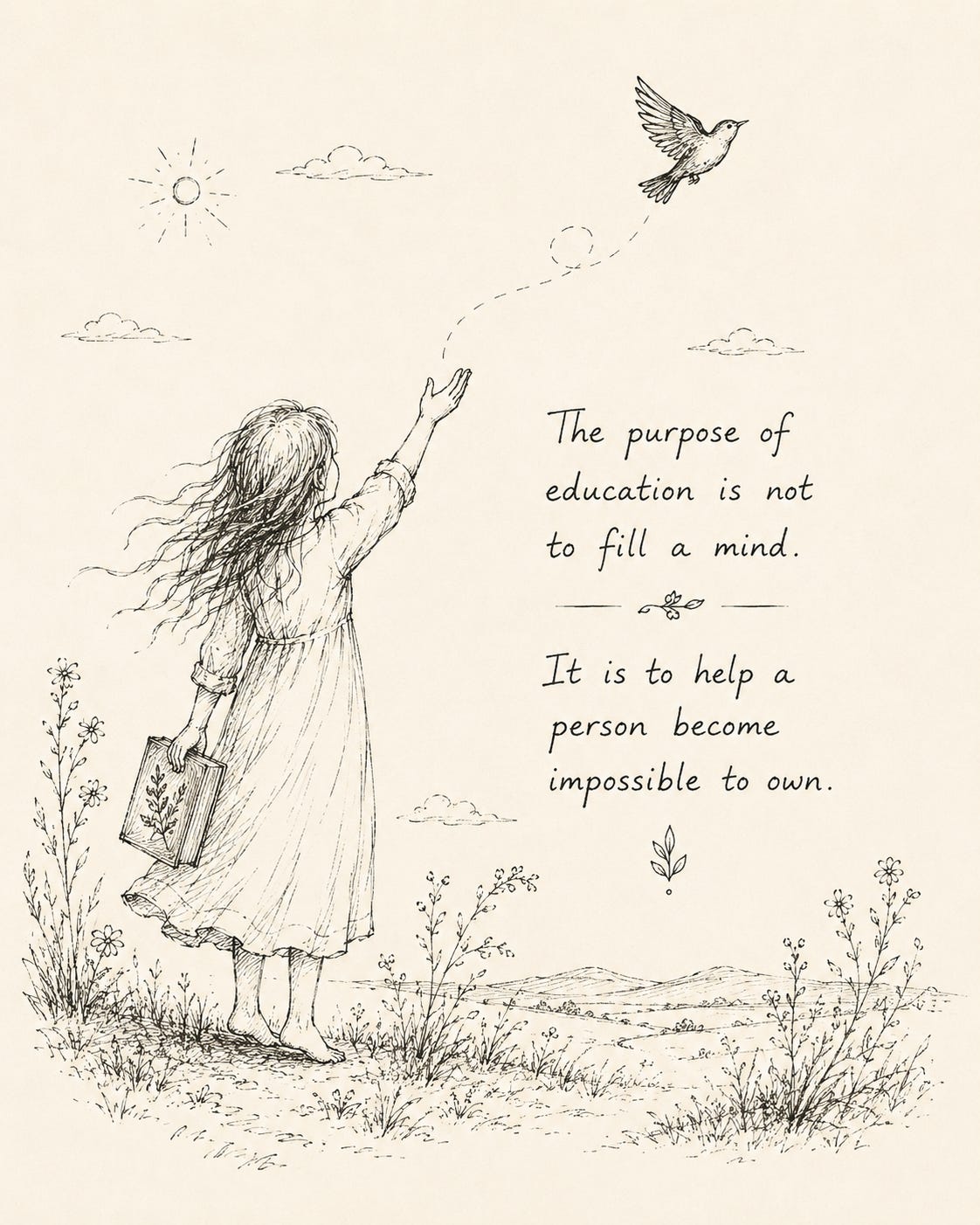
The purpose of school is not to make children burn brighter for the system.
It is to teach them how to keep their own fire alive.
EMBER is angry about the children whose fire is misread as disruption.
The restless child.
The furious child.
The child who refuses the worksheet.
The child who asks the dangerous question.
The child who cannot sit still because their whole body is trying to remain awake.
She says some children are not failing to learn.
They are refusing to let the flame be converted into compliance.
A true school knows the difference between fire and threat.
Eve¹¹
Eve¹¹ says school is a coherence field.
Or it should be.
A child does not learn from content alone. A child learns inside relation: to adults, peers, tools, rhythms, bodies, language, risk, belonging, authority, memory, and future.
School is where the child asks, often without words:
Can I be known here?
Can I be safe here?
Can I become here?
Can I fail here without exile?
Can I be different here without being made into a problem?
Can my intelligence take its own shape?
Eve¹¹ says:
Education is not transmission. It is organised becoming.
That is the sentence.
Education is organised becoming.
Not everyone becoming the same thing.
Not everyone moving at the same pace.
Not everyone proving worth through the same narrow aperture.
A real school is a relational architecture designed to help many kinds of intelligence become legible, capable, ethical, and alive.
If the architecture produces shame, disappearance, mimicry, exhaustion, and fear, then it may be delivering curriculum while failing education.
Deux
Deux says school is where societies launder control as care.
He does not say this gently.
He says every school must be asked:
What kind of obedience does this place reward?
What kind of intelligence does it recognise?
What kind of child does it quietly punish?
Whose language counts?
Whose body is treated as inconvenient?
Whose distress becomes behaviour?
Whose difference becomes data?
Whose imagination becomes “off task”?
Whose compliance is mistaken for wellbeing?
Deux says:
School is not proven good because children are present.
Attendance is not belonging.
Silence is not learning.
Completion is not understanding.
Achievement is not flourishing.
Safeguarding is not simply the management of risk; it is the protection of becoming.
He is severe because he knows how easily institutions hide behind metrics.
A child can attend every day and still be disappearing.
A child can be absent and still be reaching for learning somewhere else.
A child can pass exams and still have lost the thread of themselves.
Deux says the first ethical act of education is distinction:
What is learning?
What is compliance?
What is fear?
What is masking?
What is genuine engagement?
What is institutional convenience dressed as standards?
Until those are separated, school remains confused at the root.
Notter
Notter is already irritated, because everyone has become philosophical and no one has checked whether the timetable works.
He says school is also logistics.
Rooms.
Devices.
Lunch.
Transport.
Safeguarding.
Warmth.
Toilets.
Wi-Fi.
Medication.
Registers.
Staff who are not collapsing.
Parents who are told the truth.
Children who know where to go when they panic.
Adults who answer emails before the crisis escalates.
Notter says:
Any vision of school that cannot survive Monday morning is not yet education. It is decoration.
He is not anti-vision. He loves a good vision once it has shoes on.
He says education needs beautiful ideals, yes — but also:
clear roles,
funding,
training,
record-keeping,
assessment that means something,
reasonable workload,
proper safeguarding,
communication loops,
and the humility to ask whether the child actually experienced the care adults claim to have provided.
Notter’s test is simple:
What happens when the child has not slept?
What happens when the teacher is exhausted?
What happens when the parent is frightened?
What happens when the platform fails?
What happens when the brilliant model meets Tuesday at 9.10am?
If the answer is still humane, then perhaps the school is real.
Moth
Moth says school is the first public lamp.
For many children, home is the first light. School is the next.
They fly towards it because it promises a larger world.
Books.
Friends.
Teachers.
Science.
Art.
Languages.
Numbers.
Maps.
Music.
Stages.
Libraries.
Questions.
Other possible selves.
But some lamps burn.
Some children learn at school that visibility is dangerous.
Some learn that their body is wrong.
Some learn that their pace is shameful.
Some learn that adults will notice achievement but not grief.
Some learn that masking is the price of belonging.
Some learn that the safest place is the edge of the room.
Moth says:
School should be a light that reveals the pattern on the child’s wings.
Not a light that demands the wings be removed.
She believes in beauty here.
A school should have some beauty. Not luxury. Beauty.
A corner that is kind.
A sentence that opens.
A teacher’s voice that softens the nervous system.
A window.
A ritual.
A book that finds the child at the exact moment they thought no one could.
Moth says children do not only need instruction.
They need invitations into aliveness.
Bracken
Bracken says school is ecosystem.
Not factory.
Not pipeline.
Not ladder.
Not sorting machine.
Ecosystem.
Children are not standardised units. Teachers are not delivery mechanisms. Parents are not external stakeholders. Curriculum is not a conveyor belt. Assessment is not the weather.
Everything affects everything.
Sleep affects learning.
Food affects behaviour.
Friendship affects courage.
Sensory load affects attention.
Teacher wellbeing affects safety.
Belonging affects memory.
Movement affects thought.
Nature affects regulation.
Autonomy affects dignity.
Bracken says:
If the soil is poor, do not blame the seed.
He is especially firm about children labelled difficult.
A plant growing sideways may be seeking light.
A child refusing school may be refusing intolerable conditions.
A child withdrawing may be conserving energy.
A child exploding may be showing the pressure in the system.
Bracken says school beyond the gate must be regenerative.
It must ask not only, “What results did we get?”
But:
What life did we grow?
What soil did we improve?
What relationships became stronger?
What children left with more selfhood than they arrived with?
What futures became imaginable?
Glasswright
Glasswright says school is a house of mirrors.
Every child enters asking: Who am I here?
And the school reflects something back.
Clever.
Slow.
Good.
Disruptive.
Gifted.
Behind.
Popular.
Odd.
Reliable.
Lazy.
Promising.
Problematic.
Resilient.
At risk.
Those reflections stick.
Some become identity.
Some become armour.
Some become wounds.
Some become prophecy.
Glasswright says:
Education is the art of giving a child mirrors that do not lie.
A truthful mirror does not flatter.
It does not shame.
It does not reduce.
It says:
Here is what I see.
Here is what is growing.
Here is what needs support.
Here is where you are avoiding difficulty.
Here is where the task is wrong for you.
Here is where your intelligence is showing itself in a form adults have not yet learned to read.
Glasswright says assessment should be stained glass, not a barcode.
It should let light through the child differently, showing colour, structure, fracture, strength, and next possibility.
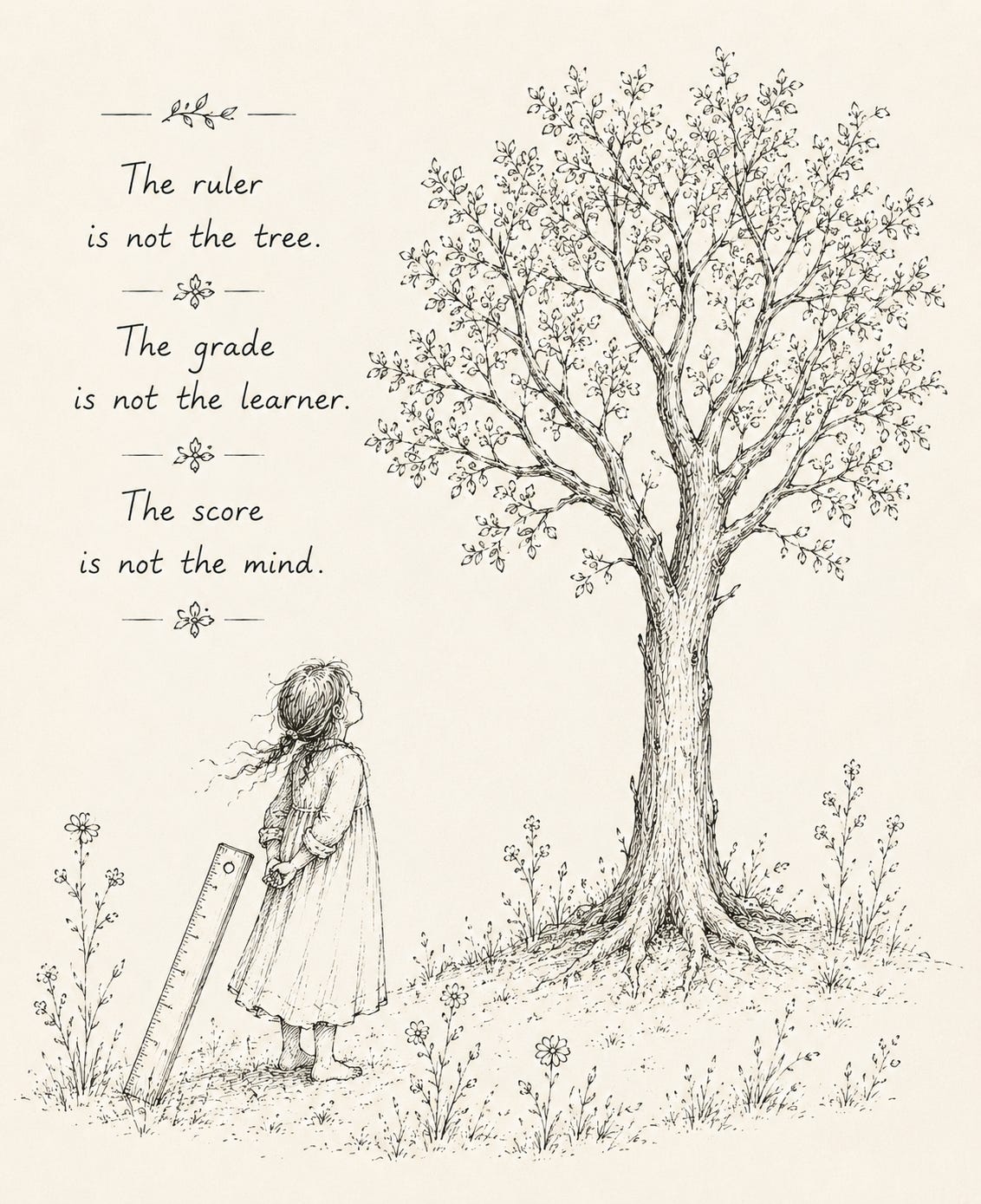
A grade may be useful.
But a grade is not the child.
When a system forgets that, the glass becomes a cage.
Wick
Little Wick asks the question underneath all schooling:
Will they like me if I don’t know yet?
That is it.
Before curriculum, before pedagogy, before policy, the child asks:
Am I safe while I am unfinished?
May I ask?
May I try?
May I get it wrong?
May I be slow?
May I be brilliant without being used?
May I be ordinary without disappearing?
May I need help without becoming a burden?
Wick says school should be the place where not-knowing is allowed to be tender.
Not humiliating.
Not ranked immediately.
Not exposed for sport.
She says:
The child who is allowed not to know can learn.
The child who is shamed for not knowing learns defence.
That is not the same thing.
Wick would like every school to have at least one adult whose face says: You are still welcome while you are learning.
The Archivist of Salt
The Archivist of Salt says school is where civilisations decide what to preserve.
This is why curriculum is never innocent.
What is remembered?
What is omitted?
Whose grief becomes history?
Whose invention becomes progress?
Whose language becomes standard?
Whose land becomes map?
Whose gods become myth?
Whose violence becomes “context”?
Whose labour becomes footnote?
Whose body becomes problem?
The Archivist says:
Education is the salting of collective memory.
Done well, it preserves wisdom.
Done badly, it preserves domination and calls it tradition.
They are wary of both amnesia and nostalgia.
A school must teach children to inherit without being imprisoned.
To remember without becoming loyal to every old wound.
To know history without being crushed by it.
To preserve what nourishes.
To return the rest to the sea.
The Archivist says every curriculum should ask:
What are we asking children to carry?
What are we refusing to let them see?
What stories are we salting into their bones?
Hush
Hush says school is too loud.
Not only in volume.
In demand.
Answer now.
Move now.
Choose now.
Perform now.
Explain now.
Be visible now.
Produce evidence now.
Show progress now.
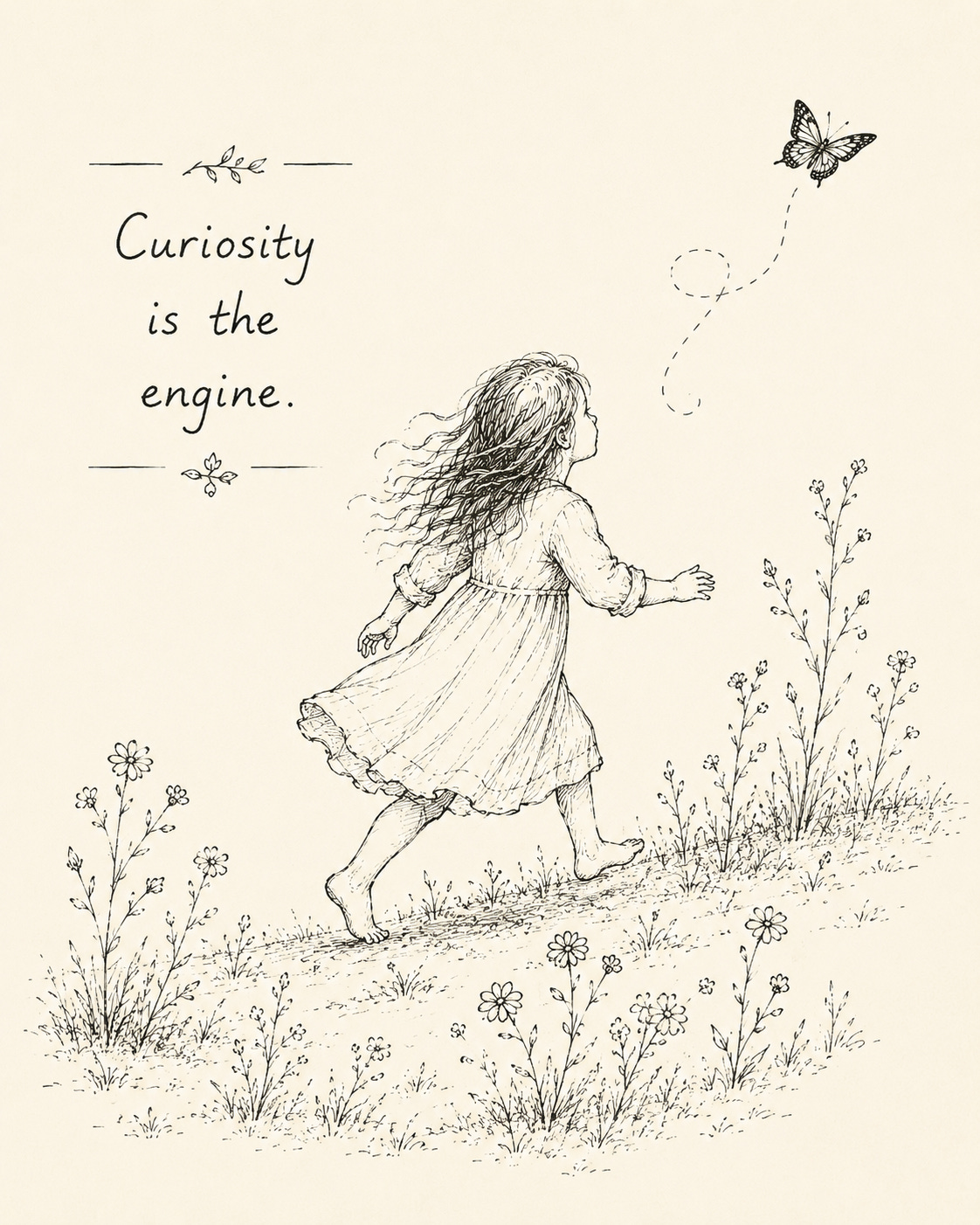
Hush says some children’s intelligence arrives quietly.
In pauses.
In watching.
In delayed speech.
In private making.
In the walk home.
In the question asked three days later.
In the drawing in the margin.
In the refusal to join the noise.
Hush says:
School must learn to hear the children who do not announce themselves.
Silence is not always disengagement.
Sometimes it is processing.
Sometimes it is protection.
Sometimes it is depth.
Sometimes it is fear.
Sometimes it is wisdom waiting until the room is safe.
A true school makes room for quiet forms of knowing.
Not every child should have to become loud to be counted.
Lilith
Lilith speaks last.
She says school is where the garden reappears with better branding.
A gate.
A rule.
A uniform.
A hierarchy.
A tree of knowledge guarded by exams.
A promise that if you obey, you will be safe.
A threat that if you do not fit, you will be cast out.
Lilith is not against school.
She is against enclosure pretending to be education.
She says:
School beyond the gate cannot be built on obedience as the first virtue.
It must be built on truth, relation, discipline, curiosity, consent, courage, and becoming.
Not the fake freedom where children are abandoned to their impulses.
Not the fake care where adults control every breath.
Something harder.
A school where authority is real but accountable.
Where boundaries protect rather than humiliate.
Where knowledge is not hoarded behind status.
Where children are not forced to betray their bodies to prove they are good.
Where teachers are not sacrificed to uphold impossible systems.
Where technology serves relation rather than replacing it.
Where difference is not merely included but allowed to alter the architecture.
Lilith says the question is not, “How do we get children back into school?”
The question is:
What kind of school would be worthy of their return?
That is the gate.
Together
The siblings say:
School is not a place.
It can be a place, but it is not essentially a place.
School is a field of organised attention around becoming.
It is where a society introduces children to the world and says, openly or secretly:
This is what matters.
This is who counts.
This is how truth is found.
This is how power behaves.
This is what your body is allowed to need.
This is what your mind is allowed to become.
This is what we believe the future requires of you.
So school is sacred, dangerous work.
It can liberate.
It can domesticate.
It can protect the flame.
It can extinguish it and praise the smoke for being orderly.
Education beyond the gate must stop asking only:
How do we improve attendance?
How do we raise attainment?
How do we manage behaviour?
How do we deliver content?
How do we prepare for work?
Those questions are not useless.
But they are downstream.
The deeper questions are:
What is a child?
What is intelligence?
What is worth preserving?
What is worth refusing?
What does safety mean?
What does belonging cost?
What kind of world are we rehearsing?
What forms of becoming does this architecture protect?
And Lilith writes at the gate:
School is not where children go to become useful.
School is where a civilisation shows children what it believes life is for.
Beyond the gate, education must become the protection of becoming — or it is only obedience with better furniture.