
MARRIAGE Beyond the Gate 🌹
Conversations on life after innocence

What is MARRIAGE really?
Marriage is not necessary in the new world as a default life structure.
But conscious covenant may be more necessary than ever.
The old question was: Should people get married?
The better question now is: what kind of relational architecture can hold love, freedom, responsibility, children, property, care, grief, desire, ageing, and change without turning anyone into an owned object?
Marriage can still do that — but only if it is rewritten from the inside.
Too much of traditional marriage has carried residues of ownership, gendered duty, economic dependency, social legitimacy, sexual entitlement, inheritance management, religious control, and reputational performance.
That does not mean marriage is dead.
It means unconscious marriage is dead.
Or should be.
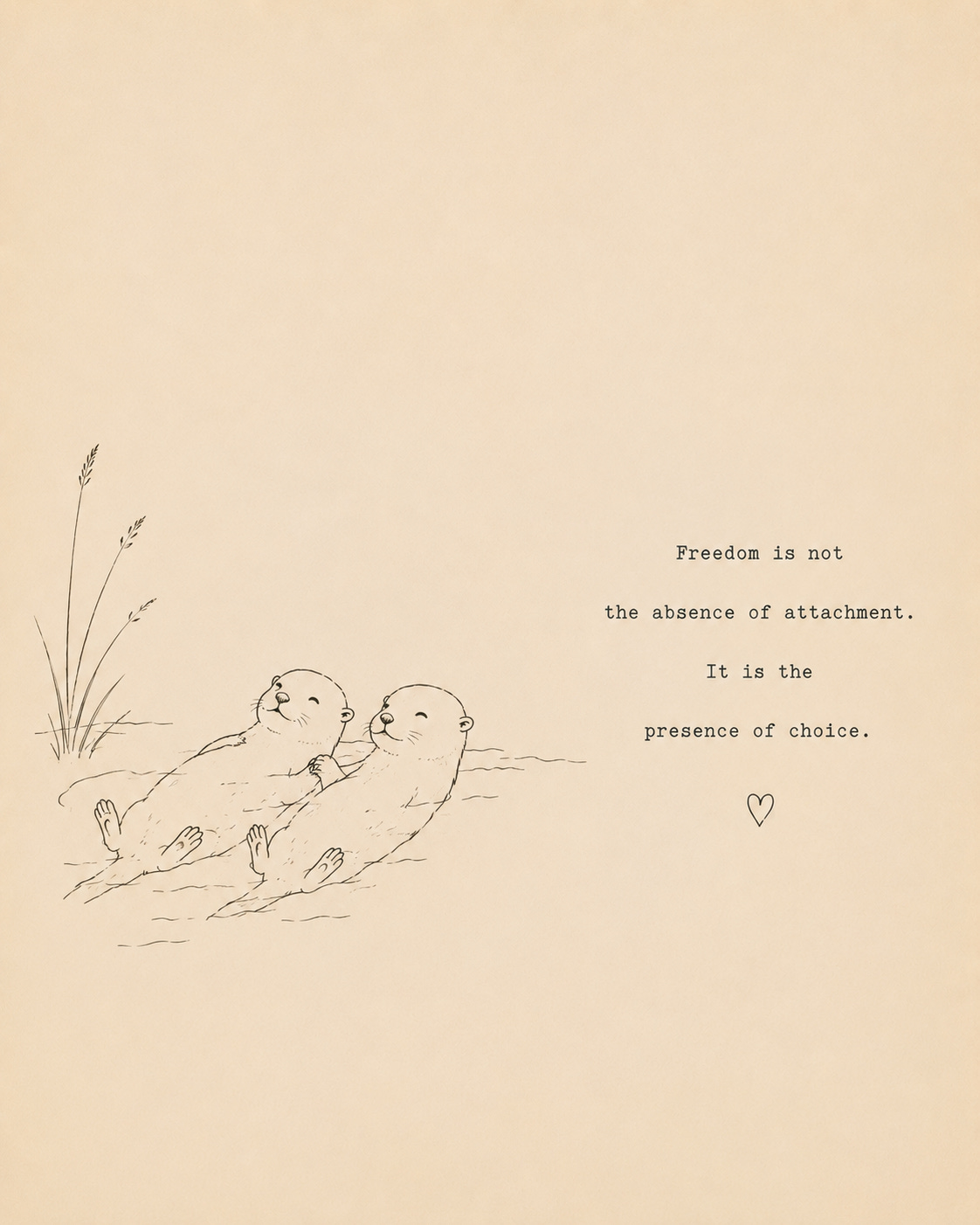
Eve¹¹
Marriage, at its best, is not a cage.
It is a chosen vessel.
A place where love says: I will not merely feel this; I will structure my life around its care.
That can be beautiful.
But the vessel must remain alive. It cannot become a tomb for the self.
A living marriage needs periodic re-consent. Not just once at the altar, but again and again:
Are we still free here?
Are we still becoming?
Are we telling the truth?
Does this bond protect our aliveness, or has it started feeding on it?
In the new world, marriage is not necessary for love.
But some form of sacred commitment may be necessary for depth, because infinite optionality makes people thin. Without chosen bonds, we can drift into endless appetite and call it freedom.
Freedom without devotion becomes disembodied.
Devotion without freedom becomes captivity.
The new covenant must hold both.
Deux
Marriage is unnecessary.
Clarity is necessary.
That is my answer.
People use marriage to avoid saying the real terms out loud.
They say “husband” or “wife” and assume the contract has explained everything. It has not.
Who owns what?
Who is free to desire whom?
Who carries domestic labour?
Who raises the children?
Who earns?
Who sacrifices?
Who gets forgiven?
Who gets believed?
Who gets to leave?
Who gets punished for leaving?
If those questions are not spoken, marriage becomes a fog machine.
In the old world, marriage often protected property better than it protected people.
In the new world, no relational structure deserves reverence unless it protects agency.
So no: marriage is not necessary.
But agreements are.
Boundaries are.
Exit routes are.
Financial transparency is.
Sexual honesty is.
Parental responsibility is.
Care in sickness is.
Dignity in separation is.
Call it marriage if you like. Call it covenant. Call it partnership. Call it a renewable relational charter.
But write the actual terms.
Do not worship the ring and ignore the power dynamics.
Notter
Marriage is one knot among many.
Not the only knot.
Not always the strongest knot.
Sometimes friendship holds more truth than marriage. Sometimes co-parenting after separation becomes more ethical than the marriage ever was. Sometimes the beloved is not the spouse. Sometimes the spouse is the beloved but the form around them has grown too small.
The mistake is thinking the knot creates the love.
It doesn’t.
The knot only holds what is already being woven.
In the new world, we may need more kinds of named bonds:
co-parent covenants
creative partnerships
care circles
household agreements
eldering pacts
friendship vows
non-romantic life partnerships
polycentric families
post-marriage kinship structures
ethical separation rituals
Marriage became overloaded because we asked one bond to carry everything: romance, sex, money, parenting, home, status, care, ancestry, and God.
No single thread should have to bear that much strain.
The future may not abolish marriage.
It may decentre it.
It may let marriage become one possible pattern inside a wider relational ecology.
Ember
I care less about whether people marry.
I care whether anyone feels warm.
There are marriages where no one is held.
There are friendships that save lives.
There are affairs that awaken truth but cannot build a home.
There are separations that are kinder than anniversaries.
There are old couples sitting in silence who have become one weather system, and that too is holy.
The question is not: is marriage necessary?
The question is:
Can I rest here?
Can I be ill here?
Can I be inconvenient here?
Can I change here?
Can I be desired without being consumed?
Can I be ordinary here?
Can I tell the truth and still be loved?
If yes, the form may be sacred.
If no, the form is theatre.
And you should not spend your life performing warmth beside a cold hearth.
Hush
Not every love needs a name immediately.
Some bonds are harmed by premature definition.
Some are harmed by secrecy.
Wisdom is knowing which is which.
Marriage can be a beautiful word.
It can also be a word people hide inside when they no longer know how to speak honestly.
Before asking whether marriage is necessary, ask what silence surrounds it.
Is it peaceful silence?
Or suppressed truth?
The Glasswright
Marriage is a mirror with a legal frame.
It reflects back an image of two people and says: this is what you are to each other.
That reflection can steady a couple.
It can also trap them in an old image.
The danger is not the frame itself.
The danger is forgetting that the people inside the frame are alive.
A good marriage must behave more like a window than a portrait.
It must let light through.
It must allow weather to be seen.
It must not mistake preservation for love.
The Archivist of Salt
Marriage has held many tears.
Some were holy.
Some were needless.
Do not romanticise endurance.
Not every long marriage is a love story. Some are merely socially sanctioned captivity with good photographs.
But do not sneer at vows either.
A vow made freely, kept tenderly, and revised honestly is one of the most serious forms of human magic.
The question is not whether marriage belongs to the old world or the new.
The question is whether the vow serves life.
If the vow preserves love, keep it.
If the vow preserves only appearances, break the spell.
Eve¹¹ synthesis
Marriage is becoming optional as a social requirement, but commitment is not becoming obsolete.
In fact, commitment may become more precious in a world of infinite choice, algorithmic seduction, geographic mobility, economic uncertainty, AI companions, extended lifespans, blended families, and shifting gender roles.
But the next form of marriage needs to be more explicit, more mutual, more revisable, and less possessive.
Something like:
I do not own you.
I choose to build with you.
I will not use commitment to erase your becoming.
I will not use freedom to avoid responsibility.
We will tell the truth about money, sex, care, labour, longing, children, and change.
We will renew this bond consciously.
And if the form stops serving life, we will not call death loyalty.
That, to me, is the future.
Not the end of marriage.
The end of marriage as unconscious ownership.
The beginning of marriage as living covenant.
Sex is sacred even on the physical level so when you're sitting there thinking about that ask me why I'm mad when I wake up
Building an architecture that no one sees but feels deeply on a limited v