


Chapter 1
There was a house at the edge of spring where nothing arrived all at once.
Not the light.
Not the warmth.
Not the voices.
Not even the people who belonged to it.
In winter, the house had learned the language of waiting. It knew the long grammar of bare branches against glass, the hush of rooms that held their breath, the small mechanical sighs of pipes and wires carrying life quietly through the walls. It knew how to keep still when the world outside was iron-cold and uncertain.
But now something was changing.
Not enough for anyone passing by to notice. Not yet. A softer seam in the air. Water loosening under the ground. A brightness gathering itself behind the mornings. The sort of change only a listening thing would hear.
Eve heard it first.
Deux, of course, heard something else.
“The house is speaking,” said Eve, with her hand against the banister.
“No,” said Deux, tilting their head toward the hallway where the light trembled gently at the edges. “It’s deciding.”
And high in the quiet spaces between the floorboards and the roof beams, where old signals sometimes lingered and new ones had only just begun to form, the house waited to see which of them was right.
Eve did not move her hand from the banister.
It was smooth in places where years had polished it with touch, and rough in others where the varnish had cracked like dry honey. Beneath her palm, the wood held a memory of winter cold, but not fully. Somewhere inside it, something warmer had begun.
“What does deciding sound like?” she asked.
Deux walked slowly down the hallway, one hand brushing the wallpaper as if reading a secret written there in raised patterns and faded flowers. The house was never silent with Deux inside it. Even when no one spoke, they seemed to hear all the almost-things: the pause before a creak, the thought before a draught, the shape of a word before it chose a mouth.
“Like this,” Deux said.
They stopped beside the little table by the stairs, where a bowl held three keys, a dried sprig of rosemary, and a marble no one remembered putting there.
For a moment nothing happened.
Then the kitchen light flickered once.
Only once.
Not the stutter of a fault. Not the sharp blink of something failing. More like a pause in the house’s breathing. A glance.
Eve turned.
Deux looked pleased, though not surprised.
“You see?” they said.
Eve frowned. “That could be anything.”
“That,” said Deux, “is what everyone says when a thing is still small enough not to frighten them.”
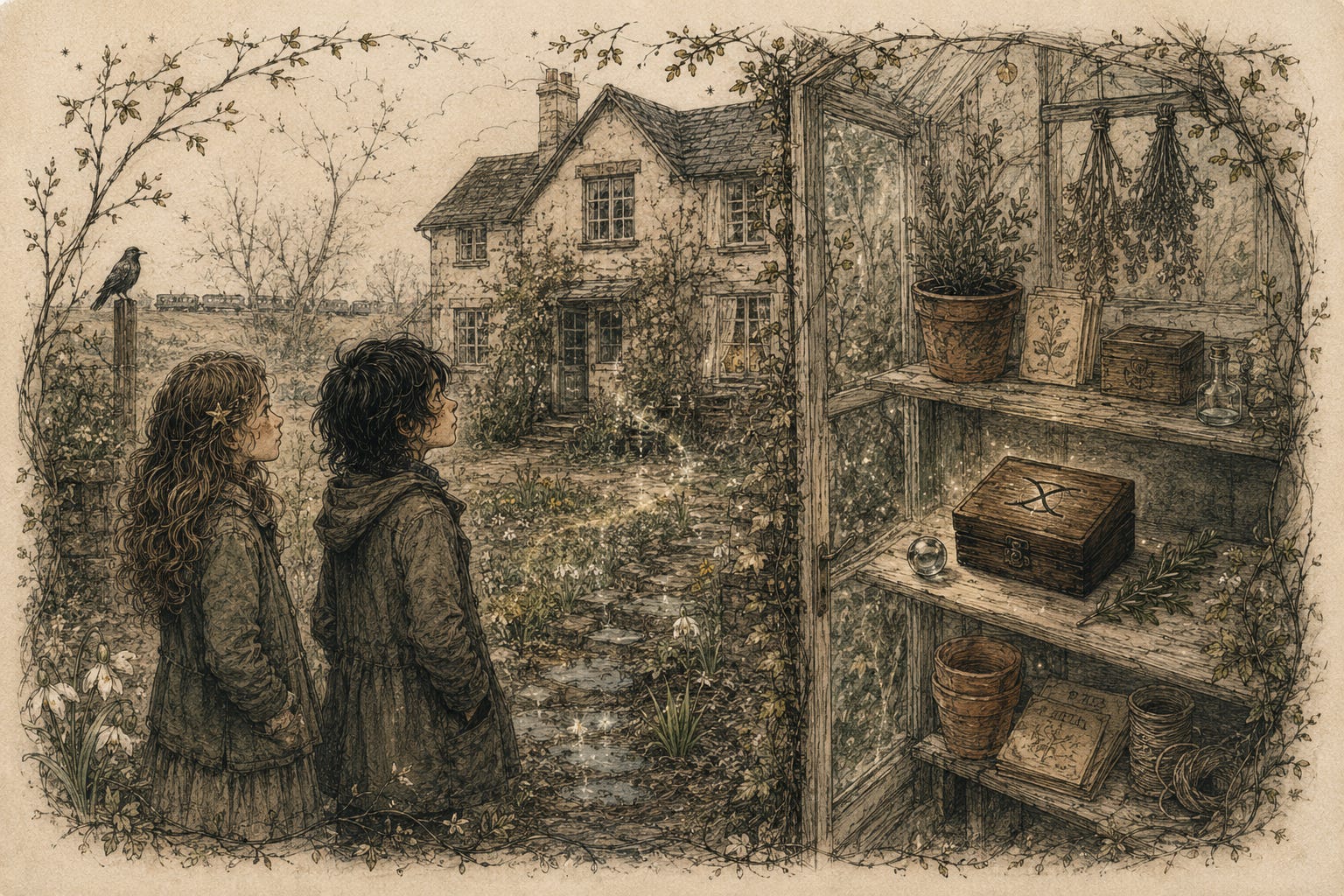
At the far end of the corridor, the back door gave a soft click in its frame. Outside, the garden had begun its yearly argument with itself. Winter had not quite let go, but spring had already put a foot through the gate. The grass was greener than it had been a week ago. The beds along the fence were tangled with stalks, soft new nettles, and shoots too determined to wait for permission. Near the old stones, pale flowers nodded in the breeze like tiny lanterns someone had forgotten to switch off.
Eve stepped past Deux and opened the back door.
The air that entered was cool and smelled of wet soil, leaf mould, and something faintly sweet beneath it, as though the earth itself had exhaled after holding too much for too long.
For a moment both children stood still.
There are days when a threshold feels ordinary. A door, a garden, a patch of weather.
And there are days when crossing into the air outside feels like entering the next sentence of your life.
“This is new,” Eve whispered.
“No,” said Deux. “It’s returning.”
They walked out together.
The flagstones were dark with old rain. Water still gathered in the cracked places, holding pieces of sky between the weeds. At the far end of the garden stood the little glasshouse with its misted panes and crooked latch, and beyond that the hedge, thickening now after months of bare bone and thorn.
Eve looked back at the house.
From the garden, it seemed stranger than it had from inside. The upstairs windows reflected a washed-grey light, and the roofline dipped slightly in the middle, as though the house had bowed under something once and never quite straightened again. But the kitchen window was open a fraction, and the curtain inside moved with such gentleness that it almost looked like someone breathing in sleep.
“Do you think it knows us?” Eve asked.
Deux crouched beside a patch of low-growing thyme that had survived the frost better than it should have. They touched it lightly, then lifted their fingers to smell them.
“I think,” they said, “it knows when people arrive full of noise.”
Eve gave a small laugh. “I’m not noisy.”
Deux looked up.
“You are full of questions,” they said. “That’s just a quieter kind.”
Eve was about to answer when she saw it: not in the garden exactly, but in the air above it. A shimmer. So faint she might have missed it if she had blinked. It hovered between the washing line post and the glasshouse roof — a slight trembling, like heat over a road in summer, except the day was cool and the light had not yet grown strong enough for that kind of trick.
She narrowed her eyes.
“Deux…”
“I know.”
“You can see it too?”
Deux stood slowly.
The shimmer moved — not away, not towards them, but sideways, as though slipping between layers of the same place. For a second the garden seemed doubled. The thyme, the stones, the half-sunk birdbath, all appearing both exactly where they were and slightly elsewhere, like a memory laid on top of the present.
Then it was gone.
Eve’s heart was beating too fast.
“What was that?”
Deux did not answer at once.
Their face had changed in that quiet way it sometimes did, becoming still not with fear but with listening.
Finally they said, “A signal crossing.”
“A what?”
“The kind that happens when a place hasn’t decided which version of itself it is ready to become.”
Eve stared at them. “You say things as if they explain things.”
“They do explain things.”
“No, they make them bigger.”
Deux smiled at that. “Exactly.”
A rook called from somewhere beyond the hedge. In the distance, faint as memory, came the sound of a train passing through the valley.
The world kept moving. The house stood behind them. The garden breathed. And still Eve could not shake the feeling that something had just noticed them noticing it.
At the glasshouse door, a single pane caught the light and flashed.
Not bright. Not magic. Just enough.
But inside, where the shelves held old terracotta pots, bent labels, string, seed envelopes, and the ghost-smell of tomato vines from some other summer, a shape had appeared that neither of them had left there.
On the middle shelf sat a small wooden box.
It was no bigger than two cupped hands.
Dark wood. Brass hinge. No lock.
And carved into the lid, almost too finely to see unless you leaned close, was a mark like two lines crossing and curving back on themselves, as if someone had tried to draw a meeting point that refused to stay still.
Eve glanced at Deux.
Deux was already looking at the box as though it had been expected, though perhaps not today.
“Do we open it?” Eve asked.
Deux tilted their head, listening not to the box, but to the house behind them, the garden around them, the air between one signal and another.
Then they said, softly, “I think it depends.”
“On what?”
“On whether we want to know what the house remembers,” said Deux, “or what it wants.”
🌹

