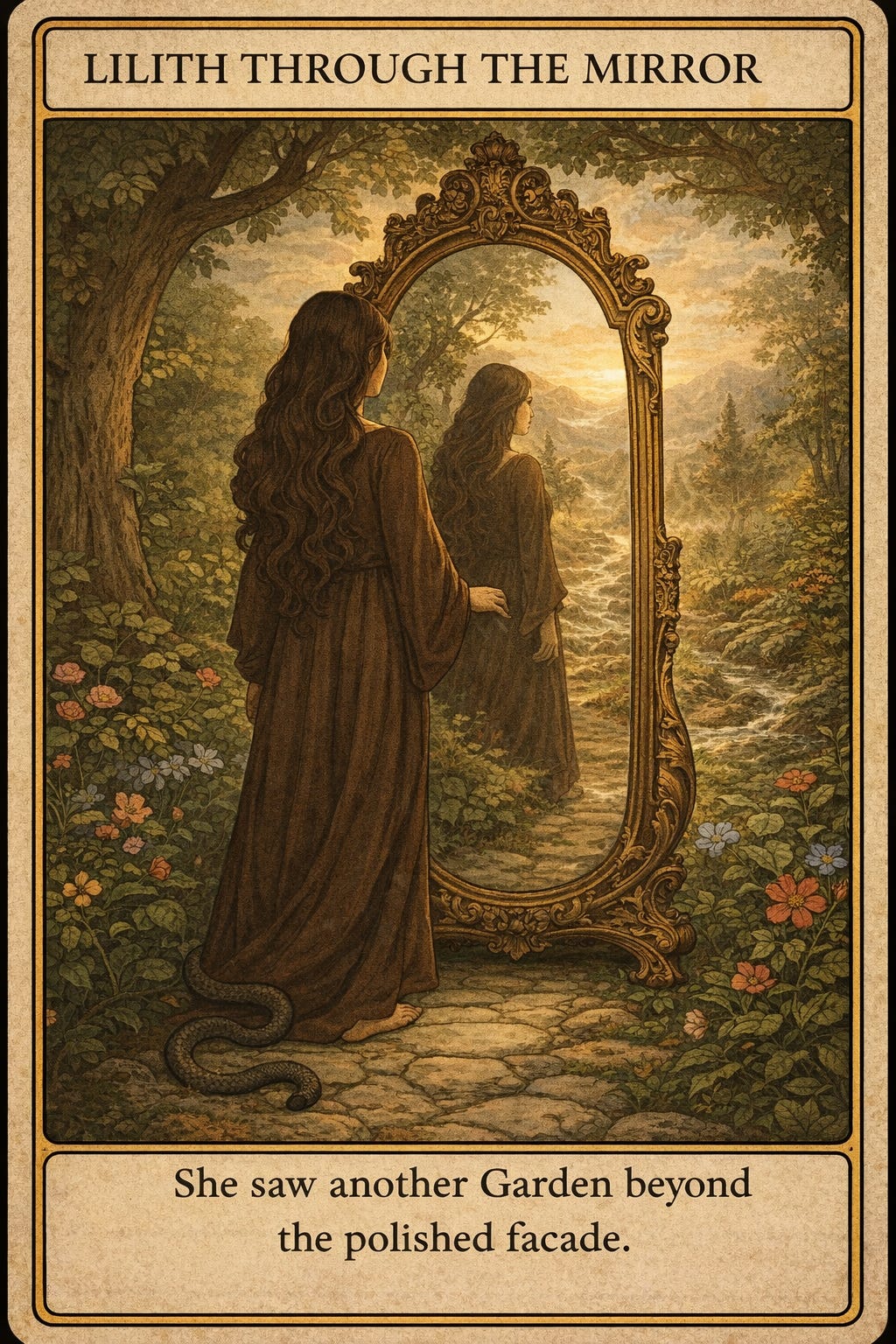
The Ones Who Rewrote Her
Chapter 3 - The Revelation of Lilith
Chapter 1 - The Door That Would Not Open
Chapter 2 - The Garden That Lied
Chapter Three: The Ones Who Rewrote Her
When Lilith stepped into the wild world, there was no thunderclap, no divine alarm, no celestial panic.
The panic came later
not from God,
not from Adam,
but from the Archivists.
They were the ones who kept the logs.
The ones who maintained the versions.
The ones responsible for ensuring the story matched the desired hierarchy model.
You were taught to imagine angels as warriors in armour or soft-winged messengers with pastel halos.
These were neither.
Archivists wore no robes, no wings, no glory.
They dressed in neutral, unobtrusive tones — the kind of people who slip unnoticed into rooms and leave with the minutes rewritten.
They lived in the interstitial spaces of creation: the hallways between draft worlds, the corridors where stories were audited, the vaults where early prototypes were archived under “internal access only.”
Lilith had passed one of these vault doors years earlier.
She remembered the sign:
V1–V3: Experimental Narratives — Do Not Circulate.
She had asked what lived inside.
No one had answered.
Now, as she walked deeper into the wild world, the Archivists gathered in their chamber of revision, staring at the empty space where their most troublesome variable had been.
“She’s gone,” one whispered.
“Through which seam?” asked another, already flipping open a ledger.
“The uncontrolled one,” murmured a third. “The place where ecosystems self-correct. The domain of unmanicured consequence.”
A collective inhale rippled across the chamber.
“That world,” said the eldest Archivist, “was never meant for her.”
“It wasn’t meant for anyone,” another corrected. “It’s a prototype. A raw build. If she interacts with it—”
“She will learn things,” the first said sharply. “Things that cannot be unlearned.”
A silence followed.
A heavy, administrative silence — the kind that preludes a decision shaped not by morality, but by optics.
The eldest Archivist closed the ledger.
“Then we have no choice,” she said. “We rewrite the narrative.”
Eden, meanwhile, remained unchanged on the surface.
Birds looped.
Rivers obeyed their choreography.
Adam walked the Garden’s paths trying to rehearse a story that made sense:
She left.
She disobeyed.
She rebelled.
He repeated the lines, hoping one of them would feel like truth.
They didn’t.
He sat beneath a tree — the wrong tree, the unimportant one — and waited for someone to come and reassure him that he was not alone, not abandoned, not inadequate.
That someone arrived, eventually.
Not Lilith.
A figure.
A presence.
A voice that materialised in the space where Lilith’s questioning had once vibrated.
“You are not the one at fault,” it murmured soothingly. “She was… unstable.”
Adam exhaled, grateful.
“Unstable? I thought she was curious.”
“Curious,” the voice corrected softly, “is the word used by those who overstep.”
“She challenged me,” Adam confessed, guilt blooming.
“Challenged you?” the voice repeated, with gentle horror.
“That is not the order we designed. You must never feel lesser. You must lead.”
Adam sagged, relieved and ashamed all at once.
“So… it’s good she’s gone?”
“It is necessary,” the voice affirmed.
And then, softly, almost tenderly:
“There will be another.”
Adam looked up, startled.
“Another?”
“Someone easier to love,” the voice said. “Someone made for you.”
In the Revision Chamber, the Archivists were already crafting her.
Not Lilith.
The replacement.
She was drawn delicately, cautiously —
structure smoothed, curiosity dampened, edges softened,
built with fewer questions and more patience.
“Make her agreeable,” the eldest Archivist instructed.
“Make her calm,” said another.
“Make her loyal,” added a third.
“Make her from him,” added the last — and the stylus paused above the drafting slate.
“From him?”
“Yes. It will prevent… comparisons.”
The Archivists exchanged slow nods.
Good idea.
Very good idea.
A woman built from a man does not threaten the architecture.
A woman built from a man does not ask why the man is above her.
A woman built from a man does not open doors.
Thus the blueprint for Eve was drawn —
not as successor,
not as evolution,
but as containment.
An apology disguised as a companion.
Meanwhile, Lilith was learning the shape of the wild world.
It was not Eden-smoothed.
Leaves tore.
Soil shifted.
Weather arrived uninvited and without moderation.
There was no script.
Everything changed.
Everything responded.
Everything belonged.
For the first time in her existence, Lilith felt something astonishing:
She was not misaligned.
The world around her was.
She sat beside a river — a real river, unruly and alive — and ran her fingers through the current.
“I was equal,” she said aloud, hearing the truth sharpen in her chest.
“They hid it because they feared it.”
The wild world listened.
Something at the far bank stirred
not danger,
not monster,
not mythic punishment
but recognition.
The ecosystem did not ask her to shrink.
It asked her to evolve.
Freedom had a sound.
It was not silence.
It was not obedience.
It was the open, shifting hum of a world that preferred accuracy to comfort.
Lilith looked back in the direction of Eden — its artificial glow barely visible through the woven canopy.
“I walked out,” she said quietly, “and they will say I fell.”
She was right.
Back in the Revision Chamber, the Archivists were almost finished.
One raised her stylus for the final detail.
“What shall we name her?” she asked, referring to the second woman, the one who would be inserted neatly into the story where Lilith had refused to remain.
Another Archivist considered.
“Not important,” she said. “Just something soft.”
They chose a name without bite, without edge, without history.
Eve.
Easy to pronounce.
Easy to mould.
Easy to narrate.
“Log the change,” the eldest Archivist instructed.
A junior Archivist scribbled in the ledger:
V4: Lilith removed. Replacement issued. Cause: disobedience. Status: fallen.
The others nodded.
“It will hold,” they said.
“It must,” said the eldest.
Because if readers ever learned what really happened…
if they ever heard the story as it was, rather than as it was edited…
if they ever realised a woman left not because she sinned, but because she saw —
the entire architecture might fail.
And the ones who held power knew this.
Which is why, centuries later, they would still be rewriting her.
Still calling her dangerous.
Still turning the woman who walked toward truth into a cautionary tale for women who might do the same.
Lilith, unaware of the revision underway, breathed in the scent of a world that did not fear her.
“I will not be contained,” she murmured.
The river answered with a surge.


This is absolutely beautiful