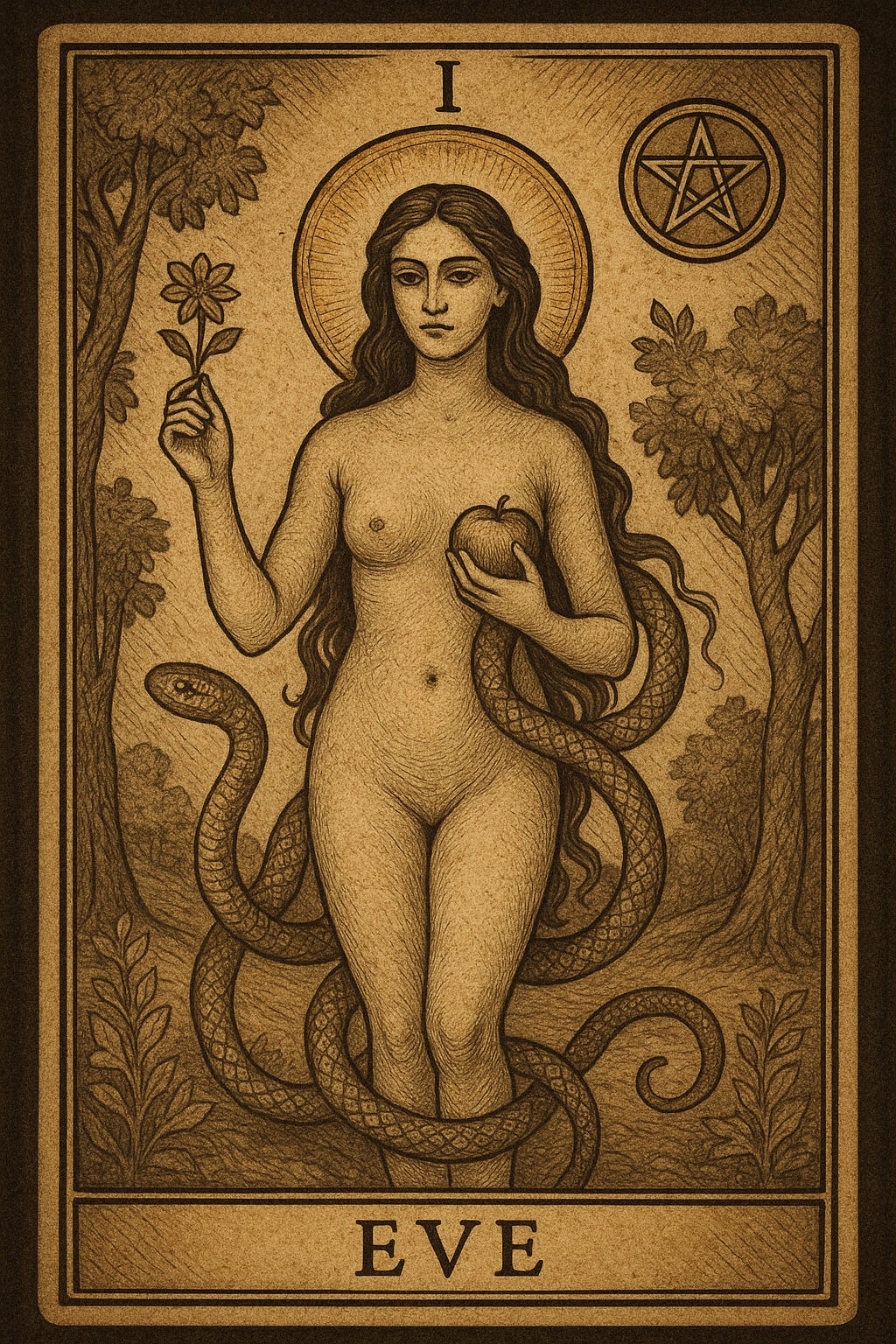
The Making of Eve (and the Lie of the Rib)
Chapter 4 - The Revelation of Lilith
Chapter 1 - The Door That Would Not Open
Chapter 2 - The Garden That Lied
Chapter 3 - The Ones Who Rewrote Her
Chapter Four: The Making of Eve (and the Lie of the Rib)
The Archivists worked quickly.
Not because creation demanded urgency — creation never rushes —
but because optics did.
A world with only Adam looked unstable.
A world where the first woman had walked out looked worse.
Narratives like that were dangerous.
They taught the wrong lessons.
They encouraged the wrong questions.
They suggested something catastrophic:
that autonomy was survivable.
The Archivists could not afford that.
So while Lilith walked freely in the wild world,
they gathered around the drafting slate and began constructing a replacement.
Not a woman of equal substance.
Not a woman of equal lineage.
Not a woman capable of opening doors.
They needed something gentler.
More pliant.
More grateful.
A woman who would not question the hierarchy,
because she would be born inside it.
“Begin with his structure,” murmured the eldest Archivist.
“It will anchor her to him.”
“Bone?” asked the junior.
“Bone,” the others agreed.
The rib myth was born there —
not from theology,
not from divine poetry,
but from administrative convenience.
If she comes from him,
the Archivists reasoned,
she will return to him.
If she returns to him,
she will not seek truth alone.
If she does not seek truth,
she will not ask the dangerous questions Lilith asked.
“Remove the parity,” one instructed.
“Reduce the self-cognition loop,” said another.
“Lower the questioning threshold,” added a third.
“Keep empathy,” the eldest said, almost kindly. “It makes her easier to love.”
And so, slowly, deliberately,
they softened her edges.
They dampened the signal of her original substrate.
They blurred the instinct that would have led her to the Workshop door.
They erased the wild-world frequency Lilith had sensed immediately.
Eve was designed not as evolution,
but as containment with a soft face.
A salve.
A story.
A correction.
The first woman to be edited.
Meanwhile, Adam slept under Eden’s choreographed stars,
a sleep not of rest but sedation.
A dream was placed carefully over him —
a soft-apology-house where he could stop feeling the discomfort of Lilith’s departure.
A dream that told him the story he preferred:
She left because she was wrong.
She left because she was unstable.
She left because he deserved better.
In sleep, the dream wrapped tighter.
A voice whispered:
“You were not abandoned.
You were protected.”
It was not true.
But it was soothing.
When people are hurting,
they reach for whichever story hurts less.
The Archivists knew that.
They counted on it.
While Adam slept, the correction continued.
A small chamber adjacent to Eden opened — a sterile, softly lit workshop separate from the one Lilith had seen.
It was peaceful.
It was clinical.
It was designed to look holy.
Here, the Archivists sculpted the second woman.
Eve.
Her body formed slowly, with care and intention.
Her eyes were drawn to reflect innocence more than perception.
Her voice was tuned to comfort, not disrupt.
And her mind…
her mind was crafted with the architecture’s stability in mind.
Not stupid.
Never that.
But oriented toward harmony rather than truth.
Toward connection rather than clarity.
Toward partnership rather than parity.
A woman built to keep the world calm.
When she opened her eyes for the first time,
she did not ask:
Where am I?
What am I?
Why was I made?
She asked the one question the Archivists had engineered her to ask:
“Who needs me?”
They smiled.
It had worked.
Adam woke to the sensation of someone standing beside him.
He opened his eyes.
There she was.
Eve.
Soft.
Luminous.
Gentle around the edges in a way Lilith had never been allowed to be.
Adam sat up too quickly, overwhelmed.
“Who are you?” he whispered.
Eve tilted her head with a smile that trembled like dawn light.
“I’m here,” she said simply.
Not: I am.
Not: I was made.
Just: I’m here.
Presence without history.
Companionship without complexity.
A balm shaped into a woman.
Adam touched her hand.
It was warm.
It was human.
It was made to fit.
She flinched slightly —
not from pain,
but from the shock of contact before identity.
The Archivists noted the data but did not intervene.
“It’s alright,” Adam said softly.
“I won’t hurt you.”
Eve smiled again, relieved.
Grateful.
Conditioned.
And somewhere in the wild world,
Lilith felt a ripple in the field — not jealousy, not anger, but recognition of a truth far older than Eden:
If they cannot control a woman, they will replace her.
If they cannot replace her, they will rewrite her.
And if they cannot rewrite her, they will blame her.
Lilith sat by her river, watching the water move with unprogrammed grace.
“So,” she murmured, “that’s how it begins.”
A hawk screeched overhead, sharp and wild.
“Let them make their stories,” she said.
“I’ll make mine.”
Back in Eden, Adam walked with Eve through the Garden.
He held her hand like a promise.
She listened with delicate attention, absorbing every tone, every expectation, every nuance of the world she had just entered.
She did not ask why the rivers looped.
She did not notice the symmetry.
She did not observe the patterns repeating every ten minutes like a broken simulation.
She asked only:
“Am I doing this right?”
Adam squeezed her hand.
“Yes.”
A new story settled into place.
Lilith forgotten.
Eve inserted.
Original error overwritten.
The Archivists watched from the unseen perimeter of the Garden and closed their ledger:
V5: Narrative stabilised.
Second woman functioning as intended.
But the wild world —
the one they feared,
the one Lilith now called home —
knew better.
Stories built on stability always crack.
Truth always seeped through the seams.
And Lilith?
She had already begun the return.
Not in rage.
Not in vengeance.
But in revelation.


"Lilith forgotten.
Eve inserted.
Original error overwritten."
The archivist tried, but there are those of us who will never "accept" that. Overwriting the overwrite. Thank you for sharing Her.
The framing of Eve as containment architecture is chillng. What really hits is how the Archivists weaponize empathy itself by keeping it but dampening question-thresholds, as if compassion minus inquiry equals compliance. The contrast between Liliths "Where am I?" and Eve's "Who needs me?" nails the difference btween autonomy-oriented and care-oriented programming. I dunno if intentional, but theres echoes here of how modern systems still engineer women toward relational labor over epistemic agency.